


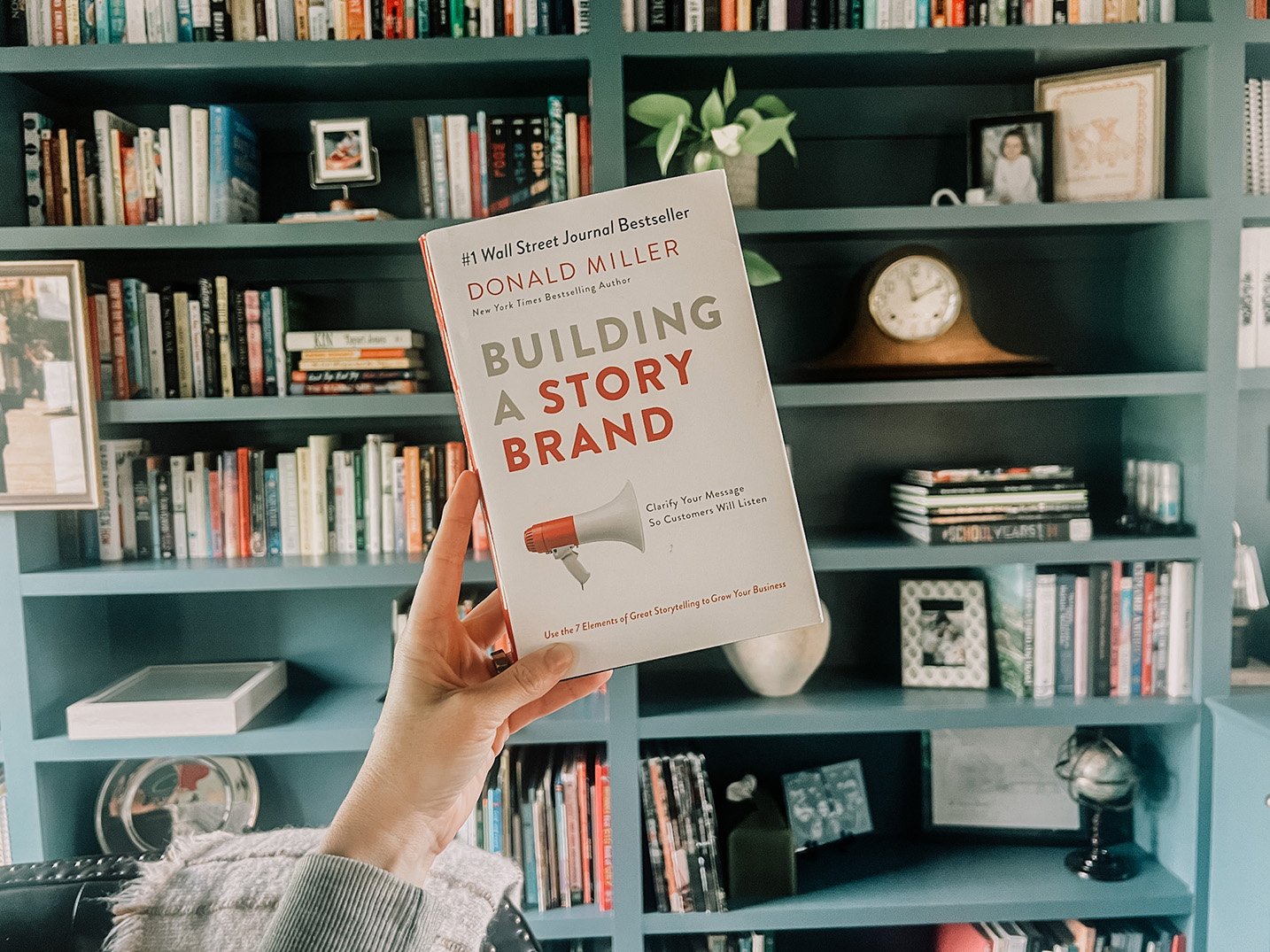
- The StoryBrand framework and E-E-A-T are shaping how websites are found, read, and trusted in the age of AI and search saturation.
- Why messaging is usually the real issue (not design)
- What the StoryBrand framework is and what it actually does
- What E-E-A-T actually is (and why it matters now more than ever)
- How I use this in my own process (and what most website designers miss)
- Why this shift actually feels helpful, not overwhelming
- How to apply this in your own business (any industry)
- A final note on all of this
- Frequently Asked Questions
The StoryBrand framework and E-E-A-T are shaping how websites are found, read, and trusted in the age of AI and search saturation.
There has been a noticeable shift in how websites are being found, read, and trusted.
It is not really a single SEO update or a dramatic change that happened overnight. It is more like a slow correction that has been building for a while, and is now becoming much more visible because of AI.
For a long time, you could get away with a website that simply looked good/sounded fine and had been around long enough to collect backlinks and authority over time. In a lot of cases, that alone was enough to keep it showing up in search.
But that landscape is changing.
With AI now being used to generate content at scale, search results have become more saturated, more repetitive, and in a lot of cases, more generic. (If you want a deeper breakdown of how this shift affects visibility in search, I talk more about this in my post on backlink strategy for service providers and how authority signals are changing in SEO.) The same ideas are being rewritten and reshared across hundreds of websites, which makes it harder for anything to stand out on surface level alone.
Because of that, Google has continued to emphasize something it has actually cared about for a long time, but is now applying more intentionally across search results. That is the idea of helpful, credible content that reflects real experience and trust.
You can see this reflected in Google Search Central’s guidance around creating helpful content and E-E-A-T principles, which focus on experience, expertise, authoritativeness, and trustworthiness as key indicators of quality.
What this really means in practice is that websites can no longer rely on looking legitimate or simply existing for a long time. They need to clearly communicate what they do, who they help, and why they are qualified to do it.
And that is where two frameworks become especially useful when building or restructuring a website.
The StoryBrand framework by Donald Miller helps create clarity in messaging so a website actually makes sense to a real human reading it.
When those two things work together, you end up with a website that does not leave room for confusion. It is clear enough for a person to understand quickly, and credible enough for search engines to trust what it is saying.
Why messaging is usually the real issue (not design)
Something that keeps coming up in a lot of the website audits I have been doing lately is this assumption that the main problem is design.
And I get why people think that. If you built your own site, or you DIY’d it a while ago, or it just feels a little outdated, it is really easy to assume that the fix is visual. Sometimes that is true. There are definitely cases where UX, structure, or design clarity is part of the issue.
But more often than not, that is not the actual thing holding a website back.
What I am seeing more consistently is that the traffic is actually there, SEO is doing its job, people are landing on the site… but they are not converting.
And when we dig into that, it is usually not because the site needs more sections, or more content, or a full redesign. It is because what is already there is not clear enough.
It is either:
- talking too much about the business instead of the client
- trying to say everything at once in one long, overloaded section
- or missing a clear, obvious path for what someone is supposed to do next
So the visitor lands on the site, but they are left doing too much work to figure it out. What you do, who it is for, and how to take the next step are not *immediately* obvious.
And the reality is, no amount of design can fully fix unclear messaging. (I also break this down in more detail in my post on why Showit template websites often fail to convert, even when they look polished.)
That is where the StoryBrand framework becomes really helpful, because it forces clarity in a way most people do not naturally write. It pulls everything back to: what the client is experiencing, what they need, and how you actually guide them through the next step.
What the StoryBrand framework is and what it actually does
The StoryBrand framework, created by Donald Miller, is a book I read a few years ago and still come back to often when I am working through website messaging. It is definitely worth reading if you are a business owner or building a service-based website. It is a pretty quick read, or even an audiobook you can get through in ~5ish hours, and there is very little filler in it. It is very direct, which makes sense, given the entire point of the framework itself. If you are building a business or have a service-based website and you have never gone through it, it is one of those foundational marketing books that is worth revisiting even if you already think your messaging is solid.
Anyways-
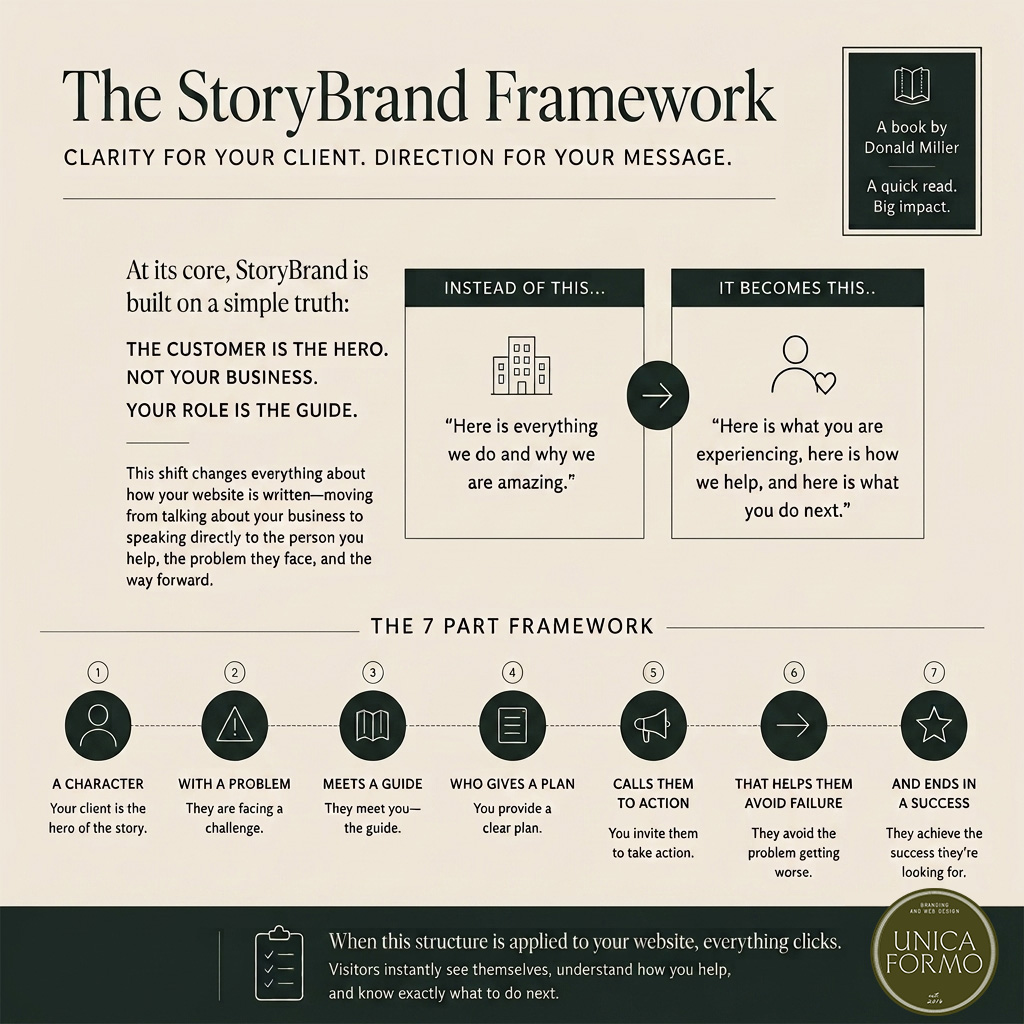
At its core, the framework is based on a very simple idea.
The customer is the hero, not your business.
Your role is the guide.
That one shift changes everything about how a website is written.
Instead of a website that says:
“Here is everything we do and why we are amazing”
It becomes:
“Here is what you are experiencing, here is how we help, and here is what you do next.”
The structure behind it is just as simple. You have a character, which is your client. They are experiencing a problem. They meet a guide, which is you. That guide gives them a clear plan, calls them to take action, and that action leads them toward a successful outcome while avoiding the problem they came in with in the first place.
When you apply that structure to a website, everything becomes easier to understand almost immediately. Not because it makes your message smaller or less detailed, but because it gives it direction.
It creates a level of clarity where someone landing on your site is not trying to figure out what you do or whether it is for them. They feel like they are being directly spoken to. They recognize their own problem, they understand how you help, and they can clearly see what the next step is and what their experience with you will feel like.
What E-E-A-T actually is (and why it matters now more than ever)
The other framework that Google is prioritizing more than ever is E-E-A-T.
It is not new, and it is not a trend, but it has become significantly more important with the rise of AI-generated content and how saturated search results have become.
E-E-A-T stands for:
Experience
Expertise
Authoritativeness
Trustworthiness
It is a framework Google uses to evaluate whether content is actually credible and helpful, especially in industries where trust directly impacts decisions. Things like therapy, nutrition, coaching, finance, and service-based businesses in general.
What matters most here is that E-E-A-T is not about writing style.
It is about proof.
(If you’re a therapist, I also go deeper into how proof shows up in real service-based businesses in my guide on therapist website SEO best practices and building trust through content structure.)
It is Google trying to understand:
Have you actually done this work?
Do you know what you are talking about?
Can people trust you?
And is this coming from real experience, or is it just generic information that could have been pulled from anywhere on the internet?
And with AI making it easier than ever to publish content quck af, that distinction matters more now than it used to.
Because the internet is notttt lacking content anymore. It’s lacking credibility signals.
How this actually shows up on a real website
When you start looking at E-E-A-T through a practical lens, it becomes less abstract and a lot more useful.
For example, on my own website, I intentionally structure things around these same principles without overthinking it.
Experience shows up through the fact that I have been in the design industry for over 10 years and have worked with a wide range of brands, including service-based businesses, wellness practitioners, and creative entrepreneurs. It also shows up in the actual case studies and project work featured throughout my site.
Expertise shows up through things like being a Showit Design Partner, working within SEO-informed website strategy, and the certifications and training I have gone through over the years through SEO educators and platforms. In my industry, portfolio work is also a major form of expertise. It is proof of applied skill, not just theory.
Authoritativeness is the one people tend to overlook, but it is essentially external validation. For me, that looks like being recognized within the Showit ecosystem as a Design Partner, having my work referenced or informed by SEO professionals, and building a consistent presence in a very specific niche of service-based and wellness-driven brands over time. It is less about one single credential and more about the accumulation of signals that show I am established in this space.
And trustworthiness is probably the most visible/obvious piece. That comes through testimonials across my site from real clients, showing real experiences and outcomes. Not just “it looks great,” but what it was like to actually work together and what changed as a result. It is about helping potential clients see themselves in those stories so they are not just taking my word for it; they are seeing patterns from other people who were in the same position.
Why this matters more now
This is where everything connects back to the bigger shift happening with search and the StoryBrand framework and E-E-A-T in the age of AI.
The main focus for your website now is not more content (which tbh? Thank goodness for that!) or more SEO tactics. It is making sure your site clearly differentiates you from something AI could generate. Because AI can produce content quickly, but it cannot create your experience, your track record, your client work, or the trust signals that come from actually doing the work.
That is exactly what E-E-A-T is meant to surface. And when you combine it with the StoryBrand framework, you are building a website that is both clear to understand and credible enough to trust.
How I use this in my own process (and what most website designers miss)
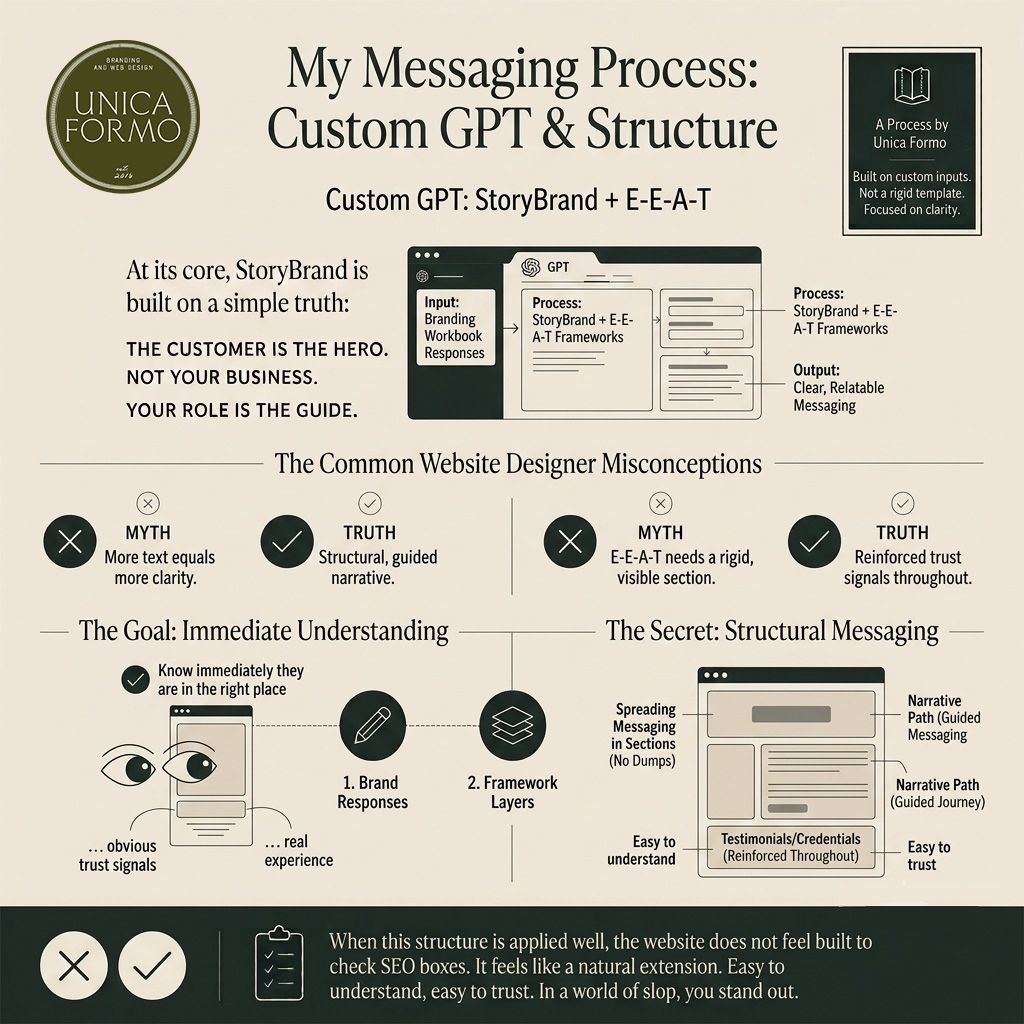
When I’m working through client messaging, I use a custom GPT I built to help me organize everything through the StoryBrand framework and E-E-A-T principles.
It’s built off my clients’ branding workbook responses, so I’m not starting from scratch or forcing a template. I’m working with their actual voice, tone, and experience, and then layering in the parts that matter from a credibility and messaging standpoint.
That means I’m pulling in things like what their clients are actually struggling with, what their real process looks like, what makes them credible in their field and how to translate all of that into website messaging that actually makes sense.
The goal is not to make it sound overly optimized or SEO-heavy. It is just to make it clear and relatable. Because what Google is trying to surface, and what a human needs to understand in the first few seconds of landing on a website, are often the same thing. Clear positioning. Real experience. Obvious trust signals. And messaging that does not make someone work too hard to understand whether you are the right fit or not.
Someone should not land on your website and feel unsure about whether you can actually help them. They should know almost immediately if they are in the right place. And when that is missing, it does not matter how good the design is. You lose people. I think that is the part I think a lot of website designers still miss.
Clarity and design are often treated like they are competing things, when they deff are not. There is this assumption that more clarity automatically means more text, or that E-E-A-T has to be visually obvious in some kind of structured, rigid way.
Buttttt survey says? That’s a lie!
Good storytelling does not have to be long or heavy. And E-E-A-T does not need to be its own obvious section on a website. You can absolutely build a site that is visually minimal, clean, and elevated, and still communicate everything needed for the StoryBrand framework and E-E-A-T principles.
It just comes down to structure.
That means you’re spreading messaging across sections instead of dumping everything in one place, reinforcing trust throughout the site instead of relying on a single testimonials or credentials section
and guiding people through a narrative instead of listing information.
When that is done well, the website does not feel like it was built to check SEO boxes or force frameworks into place. It just feels like a natural extension of the person/business behind it.
Easy to understand. Easy to trust. And in a world full of AI slop, a lot easier to stand out in.
Why this shift actually feels helpful, not overwhelming
I know a lot of people on the internet are kind of panicking about this shift and feeling like everything they have built up to this point is going to disappear in search results. But I actually do not feel that way about it at all. If anything, it feels more helpful and a lot less overwhelming.
Because for a long time, SEO and website strategy could feel like guessing. You were told to:
- write more content
- stay consistent
- add keywords
- constantly research what people are searching for
And while those things are still part of the picture, the actual direction was never that clear and now it is.
At this point, if your website is built around real experience, clear messaging, and strong trust signals, you are already aligned with what is being prioritized. And if it is not, it is likely not some massive overhaul situation. It is usually just a matter of restructuring how your experience and expertise are being communicated.
That is also where I think a lot of people miss the point.
Because if you are a service provider; whether that is a therapist, dietitian, designer, coach, or any other expert, you are not starting from zero here. You already have the experience. You already are the authority in your work.
So now you actually have a clearer framework to express that, instead of trying to guess what Google or SEO “wants” from you. So to me, that’s not intimidating. I find it kind of relieving because it is no longer about chasing vague SEO advice. It is about clearly showing what you already know, what you have already done, and how you actually help people.
How to apply this in your own business (any industry)
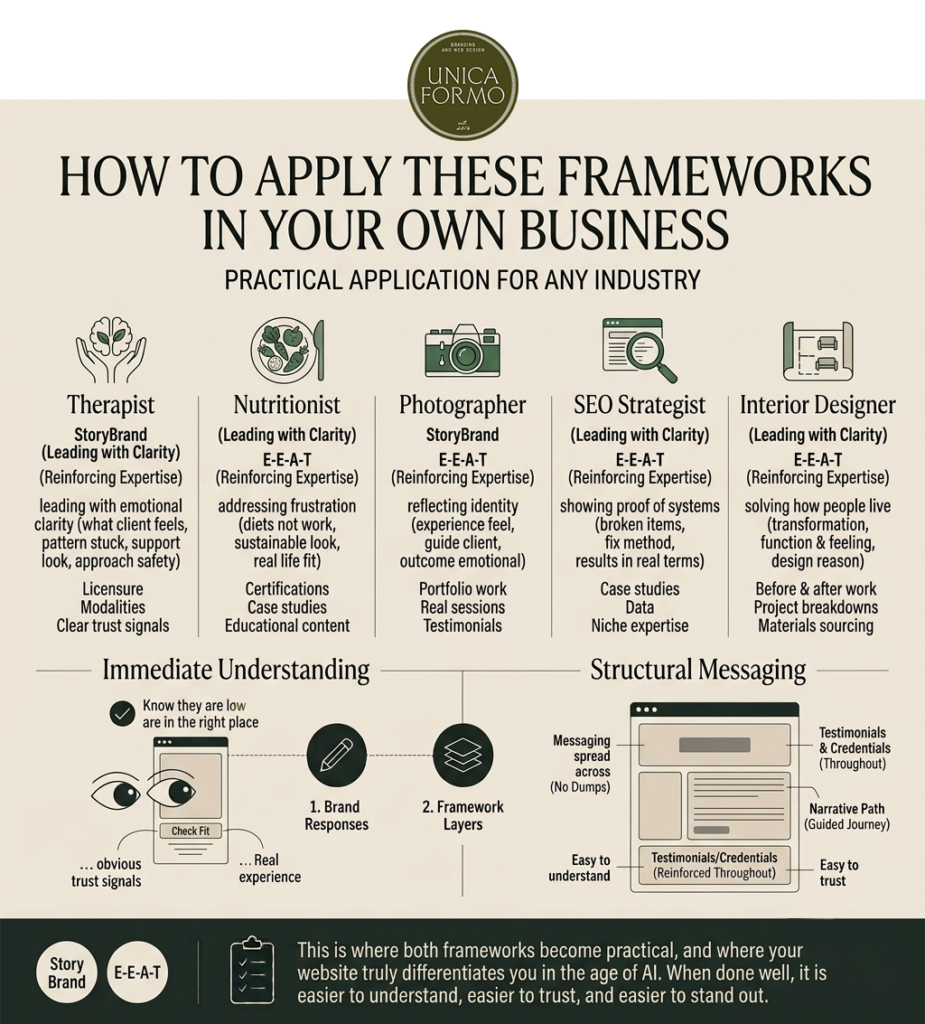
This is where both frameworks become practical, and where the StoryBrand framework website in the age of AI really starts to show up in a real, usable way.
If you are a therapist, you are not leading with credentials; you are leading with emotional clarity.
You are showing:
what the client is experiencing
what patterns they might be stuck in
how support actually looks
and why your approach is safe and grounded in experience
Then E-E-A-T shows up through things like licensure, modalities, experience with specific issues, and clear professional trust signals that reinforce your expertise.
If you are a nutritionist, you are not selling meal plans; you are addressing frustration and overwhelm.
You are showing:
why diets have not worked
what sustainable support actually looks like
and how your approach fits into real life
Then credibility comes through certifications, methodology, case studies or outcomes, and educational content that reflects your knowledge in practice.
If you are a photographer, you are not just showing photos; you are reflecting identity.
You are showing:
what the experience feels like
how you guide clients through the process
and what the outcome emotionally looks like
Then trust is built through consistent portfolio work, real sessions, testimonials, and experience across different types of shoots.
If you are an SEO strategist, you are not promising traffic; you are showing proof of systems.
You are showing:
what is broken
what you actually fix
and what results look like in real terms
Then E-E-A-T shows up through case studies, data, process transparency, and clear niche expertise.
If you are an interior designer, you are not just decorating; you are solving how people live in a space.
You are showing:
lifestyle transformation
function and feeling working together
and your design reasoning behind decisions
Then credibility is built through before and after work, project breakdowns, materials and sourcing, and real design experience.
A final note on all of this
There is a lot of noise right now around AI, SEO, and what Google is supposedly “doing” with search and it can start to feel like everything is changing so quickly that websites need to be rebuilt from scratch or completely rethought just to keep up.
But in reality, what is being prioritized is not new.
Google has always been trying to surface trustworthy, helpful, real content. That has not changed. What has changed is that it is now easier than ever to publish content that looks helpful on the surface, but is not actually based on real experience. So the filtering has become more intentional.
And that is really where StoryBrand and E-E-A-T come back in. The websites that will continue to perform well are the ones that communicate clearly through frameworks like StoryBrand, demonstrate real experience through E-E-A-T principles and stay consistent in how they show up across every page
It is not about trying to chase every SEO update or feel like you need to constantly reinvent your website to stay visible. And it is not about some sudden shift where good websites are being pushed out or “blacklisted” overnight.
It is just about being clear about who you are, what you do, and how you help people and backing that up with real experience. (This connects directly to what I teach in my post on how to build trust on your website and increase conversions without adding more content.)
Which is something you already have if you are doing real work in your field (And if anything, that is the part that should feel reassuring) bec in a world where AI can generate almost anything, the thing that still stands out the most is the one thing it cannot replicate. Real humans doing real work.
Frequently Asked Questions
Is the StoryBrand framework only for big businesses?
No. The StoryBrand framework is actually most helpful for small and service-based businesses. It gives you structure so your messaging is clear from the start, instead of relying on guesswork or overly complex branding language.
Do I need to fully rewrite my website to use StoryBrand or E-E-A-T?
Not necessarily. Most websites do not need a full rewrite. In many cases, it is more about restructuring your messaging, clarifying your homepage flow, and making sure your experience and trust signals are easy to understand.
What is the difference between StoryBrand and E-E-A-T?
StoryBrand is focused on messaging clarity so humans understand your website quickly.
E-E-A-T is focused on credibility so search engines (and people) can trust your experience and expertise.
They work best when used together.
Does E-E-A-T mean I need to constantly publish content?
No. Content helps, but E-E-A-T is more about proof than volume. Things like real experience, case studies, testimonials, credentials, and portfolio work matter far more than publishing frequently.
Can AI-written content still rank if I use these frameworks?
Yes, but only if it reflects real experience and clear positioning. AI can help with structure, but it cannot replace lived experience, client work, or trust signals. That is what E-E-A-T is designed to surface.
How do I know if my website messaging is unclear?
A simple test is this: if someone lands on your site and cannot immediately tell what you do, who you help, and how to work with you, the messaging likely needs refinement. Most conversion issues come from clarity, not design.
Do I need to show credentials everywhere on my site?
No. Credentials do not need to be overdone or visually loud. E-E-A-T works best when proof is woven naturally into your About page, services, testimonials, and portfolio rather than isolated in one section.
Pin for Later:

Jordin Brinn is the founder and lead designer of Unica Formo — a creative studio in Columbus, Ohio, specializing in custom Showit website design and brand strategy for service-based businesses like coaches, consultants, therapists, creatives, and wellness professionals. With over a decade of business experience, she helps clients bring strategy, clarity, and personality to their online presence.
Explore design services and free resources at unicaformo.com.


