



- 1. Think About What Your Ideal Nutrition Clients Are Searching For
- 2. Give Your Nutrition Specialties Their Own Space on Your Website
- 3. Make It Clear Where You Provide Nutrition Counseling
- 4. Don't Overlook Insurance Information and Appointment Details
- 5. Help Google and AI Search Tools Understand Your Credentials
- 6. Prepare Your Dietitian Website for AI-Powered Search
- 7. Write Blog Posts Based on Questions Your Nutrition Clients Actually Ask
- 8. Connect Your Website Pages With Internal Links
- 9. Measure What's Working With Google Search Console
- Frequently Asked Questions About SEO for Dietitians
- A Better Dietitian Website Starts With Clarity
If you’re a registered dietitian running a private practice, you’ve probably spent a lottttt of time thinking about how to attract new clients. Maybe you’re posting regularly on Instagram, getting referrals from other healthcare providers, or hoping potential clients will stumble across your website. But what happens when someone searches Google for a dietitian who specializes in exactly what you offer?
That’s where search engine optimization (SEO) comes in. And with more people using AI-powered search tools like ChatGPT and Google’s AI search features to research services, it’s becoming even more important that your website clearly communicates who you help, what you specialize in, and where you provide care.
The good news? You don’t need to become an SEO expert or publish a new blog post every week to make progress. You do, however, need a website that’s organized around the way your potential clients actually search.
As a Showit website designer who works with dietitians and other wellness professionals, I’ve seen how much of a difference thoughtful website structure and clear messaging can make. Let’s walk through the SEO strategies I’d prioritize for a nutrition practice, including a few things that are especially important for dietitians.

1. Think About What Your Ideal Nutrition Clients Are Searching For
One of the biggest mistakes you can make with SEO is assuming your potential clients are searching for your services using the same language you use professionally.
For example, you might describe yourself as a registered dietitian specializing in medical nutrition therapy for gastrointestinal conditions. Your potential client, on the other hand, might be searching for an “IBS dietitian near me” or “nutritionist for bloating and digestive issues.”
Neither description is necessarily wrong, but understanding the difference matters.
Before choosing keywords for your website, think about the specific problems your clients are trying to solve. Someone looking for general nutrition counseling may search very differently from someone seeking support for PCOS, an eating disorder, sports performance, or prenatal nutrition.
A gut health dietitian might want to target searches related to IBS nutrition counseling, digestive health, or virtual appointments. A sports dietitian, meanwhile, might focus on sports nutrition counseling, working with runners, or helping athletes meet their performance goals.
These are examples of potential keyword targets, not a guarantee that each phrase receives meaningful search volume. Keyword research helps determine which terms people actually use and which ones make sense for your services.
How AI Search Changes the Way People Look for Dietitians
Here’s something I find particularly interesting about AI-powered search: people aren’t necessarily searching with just two or three keywords anymore.
Instead of typing “IBS dietitian,” someone might ask an AI search tool:
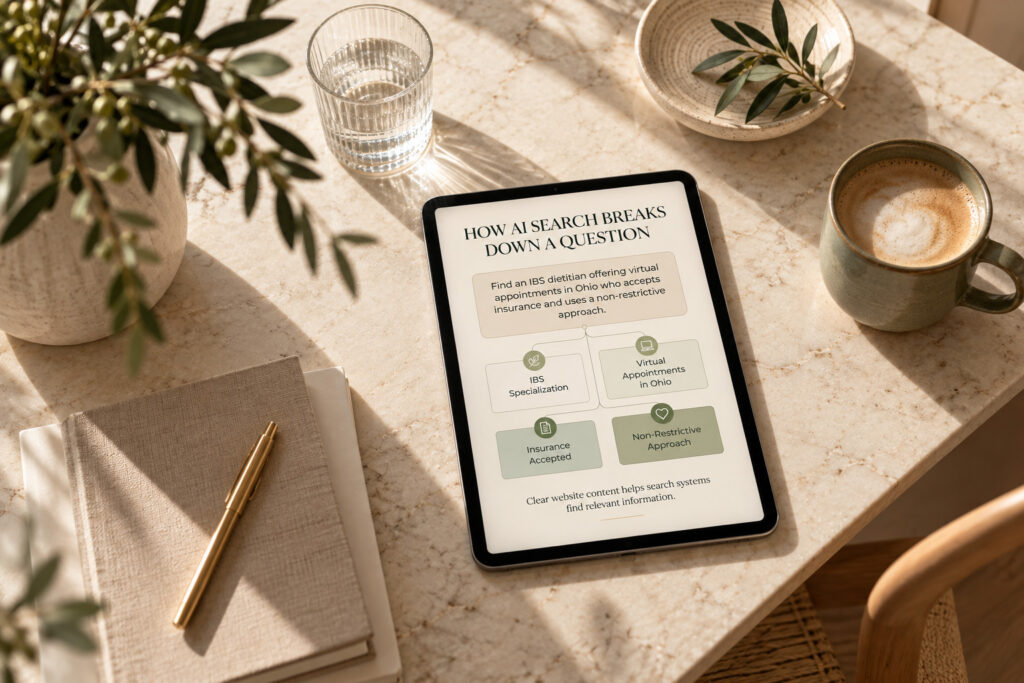
“Can you help me find a registered dietitian who specializes in IBS, offers virtual appointments in Ohio, accepts insurance, and doesn’t focus on restrictive diets?”
That’s a much more specific request, and it contains several different pieces of information.
Google has explained that its AI search features can use something called query fan-out. Essentially, the system can break a complex question into multiple related searches, gather information from different sources, and bring those results together into one response.
For the example above, those related searches might include:
- Registered dietitians specializing in IBS.
- Virtual nutrition counseling available in Ohio.
- Dietitians who accept insurance.
- Non-restrictive approaches to digestive health nutrition counseling.
These are illustrative searches, not the exact queries Google would necessarily generate. But they show why having detailed, accurate information throughout your website matters.
A potential client may be looking for several things at once, and an AI-powered search system may look for information addressing those different needs.
If your website only says that you provide “personalized nutrition services,” there’s very little detail about your specialties, approach, or availability. But if your website clearly explains that you work with IBS, offer virtual appointments in Ohio, accept certain insurance plans, and take a non-restrictive approach, there’s much more useful information available.
That doesn’t mean you need to create a separate page for every possible search variation. In fact, I’d recommend against it. Instead, focus on building a website that thoroughly and accurately explains what you offer, so your content addresses the questions your ideal clients are likely to ask.
Google discusses this process in its official guide to optimizing websites for generative AI search.
2. Give Your Nutrition Specialties Their Own Space on Your Website
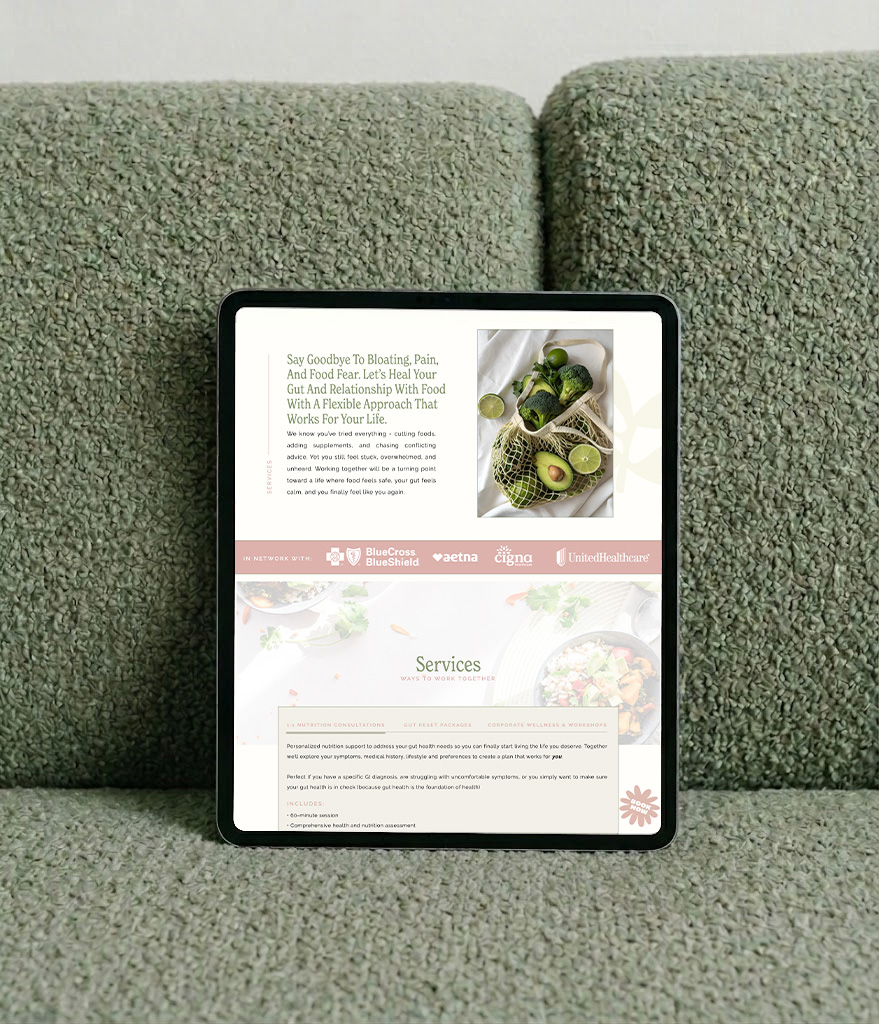
If you offer several types of nutrition counseling, putting everything into one long paragraph on your Services page may be limiting your website’s potential.
Let’s say you’re a registered dietitian who works with clients experiencing IBS, PCOS, and disordered eating. Those are three different concerns, and someone searching for support with one of them may have very different questions from someone searching for another.
Creating individual specialty pages gives you the opportunity to address those needs more thoroughly.
For example, a dietitian specializing in digestive health might have a dedicated page for IBS nutrition counseling. That page could explain who the service is for, what working together involves, the dietitian’s approach, and how someone can schedule an appointment.
The goal isn’t to create dozens of nearly identical pages just to target different keywords. It’s to give your most important services enough space to be genuinely helpful.
What Should a Dietitian Specialty Page Include?
I typically recommend starting with a clear heading identifying the service, followed by an introduction explaining who it’s for and the concerns you help address. From there, you can explain your approach, what appointments involve, and what someone can expect from working with you.
This is also a good place to include relevant professional experience, specialized training, and a few frequently asked questions. And of course, make sure there’s an obvious next step for someone who’s ready to schedule.
If you work with eating disorders, for example, your page should explain your approach to care, the populations you serve, and whether you coordinate with other treatment providers when appropriate. That’s much more useful than a generic paragraph saying you provide personalized nutrition support.
I’ve written a separate guide on creating an effective nutritionist services page if you’d like a closer look at how to organize this content.
3. Make It Clear Where You Provide Nutrition Counseling
Location is particularly important for dietitian SEO, but it’s not always as straightforward as adding your city to your homepage.
Some dietitians see clients in a physical office. Others work entirely online, and many offer a combination of both. Your website needs to communicate those details clearly.
SEO for Dietitians With a Physical Office
If you see clients in person, your city and surrounding service area should be easy to find on your website. This information can appear naturally in your homepage introduction, contact page, and relevant service descriptions.
For example, a dietitian practicing in Columbus, Ohio, might use a heading like “Nutrition Counseling in Columbus, Ohio” and explain the specialties offered at that location.
You’ll also want to claim and maintain your Google Business Profile if your practice is eligible. Accurate business information, appropriate categories, and client reviews can support your local visibility.
I’ve put together a more detailed guide on optimizing your Google Business Profile if you need help with that part.
SEO for Virtual Dietitians
If your nutrition practice operates virtually, your location strategy may look different.
Rather than targeting every state or city in the country, focus on clearly explaining where you’re authorized to provide services and how your virtual appointments work.
For example, if you offer virtual nutrition counseling to eligible clients in several states, you can explain that on your website and identify the areas you serve. Just make sure your claims accurately reflect the applicable professional requirements and your actual availability.
You generally don’t need a separate page for every state you serve. Individual location pages make more sense when there’s enough distinct, useful information to justify them.
And whether your practice is local, virtual, or both, don’t make visitors search for this information. If someone has to dig through your website to figure out whether they can work with you, they may leave before reaching your contact form.
4. Don’t Overlook Insurance Information and Appointment Details
This is one of the biggest opportunities I see for dietitian websites specifically.
Potential clients often have practical questions before they’re ready to schedule an appointment. They want to know whether you accept their insurance, how much appointments cost, whether they need a referral, and what their first session will involve.
Those questions aren’t just important for conversions. They can also help you identify useful topics and search queries for your website.
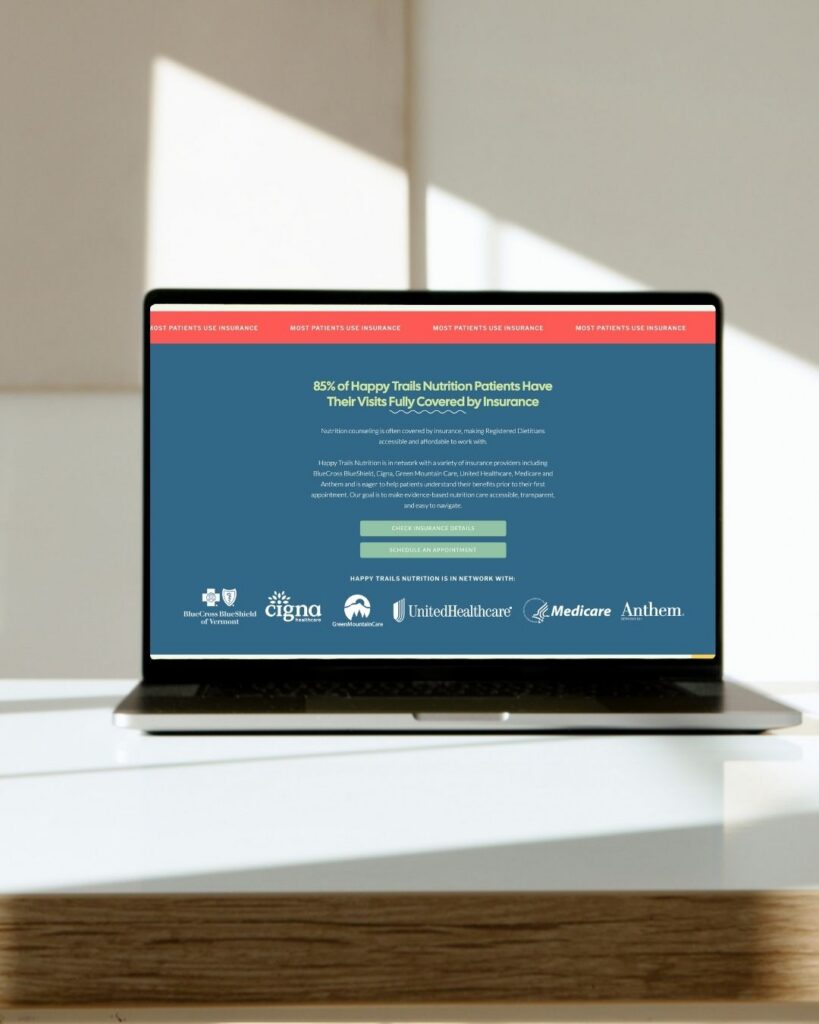
If your practice accepts insurance, consider creating a dedicated section explaining which plans you’re in network with, how clients can verify their benefits, and whether referrals may be required. If you’re private-pay or out of network, explain that clearly instead.
For example, someone researching nutrition counseling may want to know whether insurance covers appointments with a registered dietitian, whether virtual visits are eligible, or what happens if their plan doesn’t cover the service.
Of course, coverage varies by plan, service, diagnosis, and other requirements, so avoid making blanket promises about what insurance will pay for.
You don’t necessarily need an entire page dedicated to every question. But you should make sure the information is available somewhere logical and easy to find.
The same applies to scheduling. Whether you use a practice management platform, an external booking system, or a contact form, visitors should understand exactly what happens after they reach out.
5. Help Google and AI Search Tools Understand Your Credentials
Nutrition is a health-related topic, which makes accuracy, credibility, and transparency especially important.
Your website should make it easy for visitors to understand who you are, what qualifications you hold, and what experience informs your work.
For registered dietitians, that might include your RD or RDN credential, state licensure where applicable, relevant certifications, specialized training, and professional experience.
But don’t stop at listing letters after your name.
Your About page is an opportunity to explain how your experience relates to the clients you serve. If you’ve spent years working with individuals managing gastrointestinal conditions, for example, that background is relevant to someone searching for a gut health dietitian.
The same applies to your blog content. If you’re publishing nutrition education, include clear author information and support important health claims with appropriate, credible sources.
This is where Google’s emphasis on helpful, reliable content and E-E-A-T (experience, expertise, authoritativeness, and trustworthiness) becomes relevant.
I discuss that relationship in more detail in my article about the StoryBrand framework and E-E-A-T.
What About Structured Data?
Structured data, sometimes called schema markup, provides additional machine-readable information about your website and its content.
Depending on your website, appropriate markup may help identify your business, professional information, services, or articles. It should accurately reflect information visitors can already see on the page.
It’s a useful technical SEO consideration, but it isn’t a shortcut to better rankings or guaranteed AI search visibility. There also isn’t a special schema type that automatically makes your dietitian website appear in AI-generated answers.
6. Prepare Your Dietitian Website for AI-Powered Search
Traditional search isn’t the only way people discover businesses anymore. Someone might ask ChatGPT to help them find a registered dietitian specializing in PCOS, or use Google’s AI search features to research nutrition counseling options.
While you can’t control whether an AI tool recommends your practice, you can make your website easier to discover and understand.
The same foundations that support traditional SEO are still important here: accessible website content, clear descriptions of your services, accurate professional information, and helpful answers to the questions people are asking.
Google’s own guidance emphasizes that existing SEO best practices remain relevant to its AI search features. You don’t need to completely rebuild your website around a new set of AI-specific tricks.
Be Specific About Who You Help
Compare these two descriptions:
“We offer personalized nutrition counseling to help you reach your wellness goals.”
And:
“I provide virtual nutrition counseling for adults managing IBS and other digestive concerns, with a focus on practical, sustainable changes.”
The second description communicates substantially more information. It identifies the service, audience, specialty, and delivery method without relying on vague language.
That clarity benefits potential clients first, but it also gives search systems more useful context about your practice.
Make Important Information Available as Text
Your website can still include beautiful photography, graphics, and design details. But essential information about your services shouldn’t exist only inside images.
If your specialties, credentials, or appointment details are presented exclusively in graphics, they may be harder for some visitors and automated systems to access.
Use clear headings, readable text, descriptive links, and an organized page structure. You can learn more about website heading hierarchy and optimizing images for Showit in my existing tutorials.
Focus on Useful Content, Not AI Search Tricks
You may have seen recommendations to add special AI files, rewrite every paragraph as a question, or publish huge amounts of content to increase your chances of being mentioned by AI tools.
I’d be cautious about treating any of those tactics as a requirement.
Instead, focus on explaining your services accurately, demonstrating your experience, and making your website genuinely helpful for someone considering nutrition counseling.
For Google’s AI search features, its published guidance continues to emphasize original content, accessibility, and strong SEO fundamentals.
7. Write Blog Posts Based on Questions Your Nutrition Clients Actually Ask
Blogging can be a useful part of your SEO strategy, but I wouldn’t recommend writing about every nutrition trend you see online.
Your blog should support the services you want to be known for.
For example, if you specialize in PCOS, a thoughtful article answering a common question about nutrition counseling for PCOS could help potential clients understand your approach. If you work with athletes, you might address questions about what to expect from sports nutrition counseling.
A gut health dietitian could write about the differences between general nutrition advice and working individually with a dietitian for IBS. An eating disorder dietitian might explain what nutrition counseling involves as part of a coordinated treatment approach.
The key is connecting educational content to your actual services, without turning every article into a sales pitch.
It’s also important to remember that nutrition content can influence people’s health decisions. Make sure educational posts are accurate, appropriately sourced, and written within your professional scope.
If you’re unsure where to start, think about the questions you answer repeatedly during consultations. Those are often much more useful starting points than a generic list of blog ideas.
For the technical side of planning and publishing content, I’ve already covered how to blog for SEO, including how to approach keywords and organize your posts.
8. Connect Your Website Pages With Internal Links
Internal linking is one of those SEO tasks that sounds more complicated than it needs to be.
Essentially, you’re helping visitors and search engines move between related information on your website.
Let’s say you have a blog post explaining what clients can expect during their first IBS nutrition counseling appointment. That article could link to your IBS specialty page, where visitors can learn more about working with you.
Your IBS specialty page could then link to your About page, insurance information, or appointment scheduling page.
These connections help visitors find the next piece of information they need without returning to your main navigation every time.
They also help search engines discover related content and understand how different pages fit together.
I wouldn’t force links into every paragraph, though. Include them where they genuinely help the reader.
9. Measure What’s Working With Google Search Console
Once you’ve invested time in improving your website, you’ll want to know whether those changes are helping.
Google Search Console is a free tool that provides information about how your website performs in Google Search.
You can use it to see which queries generate impressions, which pages receive clicks, and where your website appears in search results.
For a dietitian, this can help you understand whether your website is appearing for your nutrition specialties, whether visitors are finding your service pages or primarily your blog posts, and which search queries are generating impressions without many clicks.
For example, if your gut health services page is receiving impressions for searches related to IBS nutrition counseling but very few clicks, it may be worth reviewing the page’s title, description, content, and how well it matches what people are looking for.
You can also use Search Console to investigate indexing problems that may prevent important pages from appearing in Google.
I have a separate tutorial on setting up Google Search Console and submitting your sitemap if you haven’t done that yet.
Keep in mind that Search Console doesn’t provide a complete picture of every time an AI assistant mentions your business. Google’s AI search performance is incorporated into its broader Search reporting, while tracking visibility across independent AI platforms requires other methods.
Frequently Asked Questions About SEO for Dietitians
Do Dietitians Need SEO?
If you want potential clients to discover your practice through search engines, SEO is worth considering. It helps search engines understand your services and can improve your opportunities to appear for relevant searches. Even a small practice can benefit from clear service pages, accurate location information, and an organized website.
Should I Use “Dietitian” or “Nutritionist” on My Website?
That depends on your credentials, audience, and how people search for your services. Registered dietitians may find that potential clients use both terms, even though the professional titles aren’t interchangeable in every context. You can naturally incorporate relevant search language while being accurate about your qualifications and avoiding any misleading claims.
Do I Need a Separate Page for Every Nutrition Specialty?
Not necessarily. I’d prioritize individual pages for your most important services, especially when they serve different audiences or answer substantially different questions. A smaller practice with one primary specialty may not need the same website structure as a group practice offering several types of nutrition counseling.
Can My Dietitian Website Appear in ChatGPT or Google’s AI Search Results?
It’s possible for publicly accessible website content to be discovered or referenced by AI-powered search systems, but no website designer or SEO strategy can guarantee that your practice will be recommended. Clear, helpful content, accurate business information, and sound technical SEO are sensible foundations.
Do I Need to Blog Regularly to Rank on Google?
No. Blogging can support your SEO strategy, but publishing frequently isn’t a requirement for ranking. I’d rather see a dietitian with a handful of useful, well-written articles that support their services than a blog filled with repetitive content created just to maintain a posting schedule.
How Long Does SEO Take for a Dietitian Website?
There isn’t a universal timeline. Results depend on factors like your website’s history, competition, location, specialties, and the quality of your existing content. SEO is generally an ongoing process, and improvements may take time to appear in search performance reports.
A Better Dietitian Website Starts With Clarity
If there’s one thing I’d encourage you to take away from this guide, it’s that SEO doesn’t need to mean adding more content to your website just for the sake of having it.
For dietitians, some of the most useful improvements are also the most practical: clearly explaining your specialties, making insurance and appointment information easy to find, showing your credentials, and helping visitors understand whether your services are right for them.
Those details matter to the people considering working with you, and they give search engines more information about your practice.
If you’re planning a new website or wondering whether your current one is doing enough, you can explore my website design work for dietitians and nutritionists. I specialize in custom Showit websites that combine thoughtful design, clear messaging, and technical SEO foundations, so your website supports both the people visiting it and the goals of your practice.

Jordin Brinn is the founder and lead designer of Unica Formo — a creative studio in Columbus, Ohio, specializing in custom Showit website design and brand strategy for service-based businesses like coaches, consultants, therapists, creatives, and wellness professionals. With over a decade of business experience, she helps clients bring strategy, clarity, and personality to their online presence.
Explore design services and free resources at unicaformo.com.


